Kite surprise on Waterworks trip
On Sunday 12 May about a dozen Wren Group members visited Waterworks Nature Reserve and Middlesex Filter Beds, just off the Lea Bridge Road.
Martha Smith (aged 9) takes up the story: “On the walk, we saw many different species of butterflies, birds and even a Fox or two. Our journey began when we looked in the bushes for butterflies, but while doing so we heard Wrens singing their merry tune in the distance. Unfortunately, we didn’t manage to see a Wren although we tried.
After searching the bushes for a few minutes we surprisingly came across a Small White butterfly and a Green-veined White butterfly! Afterwards we discovered a few kinds of plants and I found out which kind of nettles sting and which don’t. We also came across some male Blackbirds squabbling over their territory.
To our surprise, we found another wonderful species of butterfly, a Speckled Wood. Next we came to the hides, so first we looked out of a hide window and immediately spotted a male and female Mute Swan. If we were patient and waited long enough we would be able to see the nesting female’s eggs when she stood up; we finally spotted four eggs when she started preening.
Slowly but surely we made our way round every single one of the hide windows. Round the outside of one of the enclosures we saw a Fox prowling round and I assumed he/she was after the swan or her eggs. While looking, we also found some more Small Whites flying around quite sharply.
On the way out of the hides one of the group spotted a Red Kite flying high above and I got rather excited.
As it got later, with the sun beating down relentlessly, we decided to scour the meadow for some more fascinating species of butterfly. First we saw an Orange Tip butterfly but after a while of finding nothing we had almost given up. Suddenly one of us shouted to the others that she had just found a Peacock and sent Jacob to inform the others of their spectacular discovery. Fortunately they arrived in time to get some shots of this flaming deep-red butterfly laying its eggs on nettles.
Then one of the older members of the group heard the faint tap, tap, tapping of a far-off woodpecker and while most of the group went to get a closer look, I had to make my journey home.”
Birds seen or heard: Mute Swan (2), Canada Goose, Mallard, Gadwall, Pochard (12), Tufted Duck, Little Grebe (2), Cormorant, Grey Heron, Red Kite (1), Hobby (1), Moorhen, Coot, Lesser Black-backed Gull, Feral Rock Dove, Woodpigeon, Common Swift, Green Woodpecker (2), Sand Martin (1), Swallow (3), Grey Wagtail (2), Wren, Dunnock, Robin, Blackbird, Song Thrush, Reed Warbler (10+), Blackcap, Common Whitethroat, Chiffchaff (1), Willow Warbler (1), Blue Tit, Great Tit, Long-tailed Tit, Jay, Magpie, Carrion Crow, Starling, Chaffinch, Greenfinch, Goldfinch.
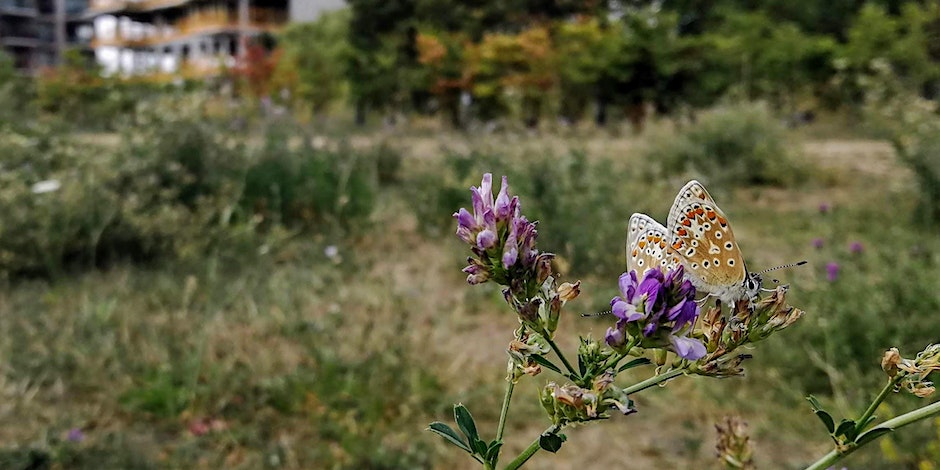
Butterflies seen: Small White, Green-veined White, Orange-tip, Holly Blue, Brimstone, Peacock, Speckled Wood, Small Tortoiseshell.
Picture credits: Anita McCullough
The bluebells are out in Chalet Wood in
Wanstead Park!
The bluebells are out in Chalet Wood in Wanstead Park! They are expected to be at their peak during next week. Come and enjoy!
An explosion of spring
Nature always finds new ways to surprise. On Sunday 14th April winter finally relinquished is icy grasp and it was great to be walking around without a thick coat for the first time in months. A group of Wren group members gathered in warm sunshine in Wanstead Park to conduct the last waterbird count of the 2012/13 winter season. Our first impression, looking out over Heronry lake, was how empty it was. Yes, there were lots of Coots on their stick-island nests. And yes, there were small groups of Tufted Ducks, the males resplendent in their black-and-white plumage, and loafing Mallards. But gone was winter’s flock of Pochard. And gone, too, were the record-breaking numbers of Gadwall that we’d grown so used to seeing. It did not promise to be a particularly dramatic count!
But first impressions can be wrong. David had already seen two Brimstone butterflies by the time he joined us, and as we were walking around the old sewage works an Orange Tip flew past. We weren’t able to get good views of this early-season species but were luckier with several Commas in the area cleared by the practical work team during the icy months. Andrew had had the foresight to bring a camera and managed to get some nice shots of one of this species nectaring on some brilliant yellow Coltsfoot. As we worked our way up the eastern side of the Ornamental Waters we saw several more Commas and the day’s butterfly variety was added to later with a Peacock near Shoulder of Mutton.
At the southern end of the Ornamentals a large mass of frog spawn got us all peering into the water. Sure enough there were several Common Frogs, some in amplexus, and at least two Common Toads. Then I heard a call of “Bat!” as Linda, Andrew and David saw what was probably a variety of pipistrelle flying through the trees. After an all-too-long winter in hibernation, bats are now desperately hungry and will emerge during the day to feast on any flying invertebrates. Not to be outdone, Pam saw a medium-sized fish, which she later identified as a young Perch.
By this time we had successfully worked our way through all the classes of vertebrate animals. (Earlier, two sunbathing Red-eared Terrapins were spied on a log at the western end of Perch pond. OK, they’re not native to the UK but they’ve been here a long time and I think they’re still of interest.)
Despite all these distractions our focus on waterbirds remained. Although we made no dramatic finds, we discovered that 16 Gadwall and seven Shoveler remained on the park’s ponds and lakes and that Little Grebes were paired up at both ends of Heronry and on Shoulder of Mutton. Also, that the Great Crested Grebes remained on the former lake. There was other bird interest, too. Three Swallows flew over during the course of the morning; we were able to watch a pair of Sparrowhawks displaying over Warren Wood; and a Common Buzzard, closely attended by Carrion Crows, drifted south over the Glade.
All in all, a great morning to be out and about. It’s amazing what a splash of warm sunshine can do.
Tim Harris
Picture: Comma on Coltsfoot by Andrew Spencer
STOP PRESS: 15 April: 27 Wheatear, 5 Common Redstart, 3 Whinchat, Ring Ouzel on Wanstead Flats.
The Wren Group’s study area
Epping Forest is an historic woodland lying in the west of the county of Essex on the ridge of high ground which separates the Lea Valley on the west from the Roding Valley on the east, and which extends southwards into what are now the London Boroughs of Redbridge, Newham and Waltham Forest.
Since 1975 members of the Wren Conservation Group have gathered records of the flora of the southern end of Epping Forest.